
Maple Card Renewal Status: How to Check in Canada
By Careviv Editorial Team, Careviv
Learn how to check your maple card renewal status, understand PR card processing times, and avoid common delays when renewing your PR card in Canada.
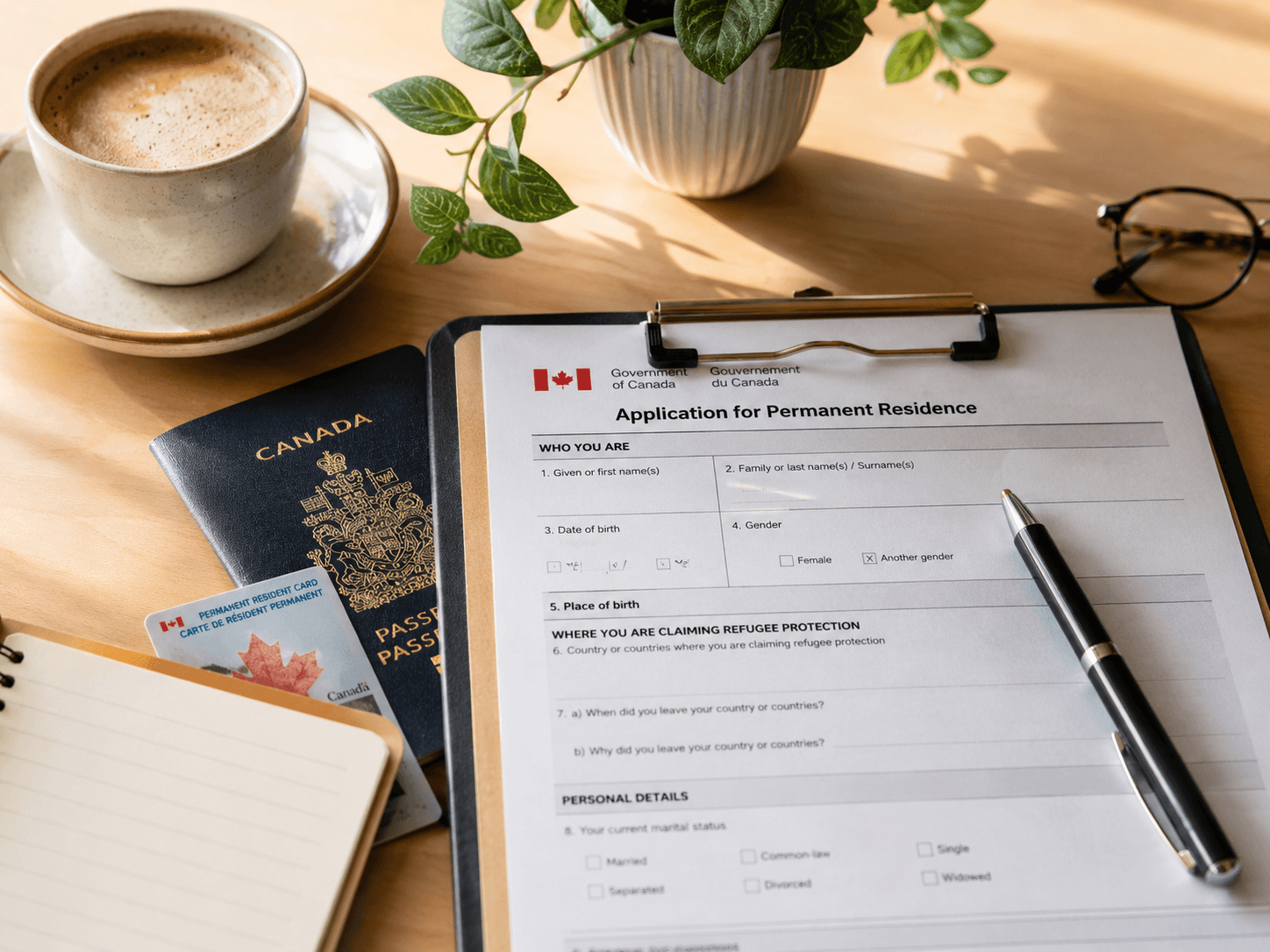
For many permanent residents, the PR card is often called the "maple card." It is not the formal government term, but it is the phrase many people use in everyday conversation. When that card is close to expiring, the same question usually follows: how do you check your maple card renewal status, and how long will the process actually take? You might also search for how to check the status of PR application, how to track PR card after COPR, PR tracker Canada, or maple card renewal status; all of these point back to the same IRCC tools for updates.
It is a fair question, because the stress is real. A PR card is not the same thing as permanent resident status itself, but it is the document most permanent residents need in order to return to Canada on a commercial flight, train, bus, or boat. If your card is expiring, if travel is coming up, or if your renewal is already in process and there has been no visible update, it can quickly start to feel bigger than "just paperwork." IRCC states that permanent residents travelling by commercial vehicle generally need a valid PR card, or a permanent resident travel document if they are outside Canada, to return to Canada.
If you are instead wondering how to check immigration status in Canada more generally, remember that the PR card is proof of status for travel, not the status itself.
The good news is that the process itself is fairly structured, even if the experience can feel slow. There are official ways to check your renewal status, there are clear rules around when you should renew, and there are common reasons why some files move faster than others. What matters is understanding what the card does, what it does not do, and how to avoid the mistakes that create unnecessary delays.
First, what a PR card renewal actually means
A PR card renewal does not "renew" your permanent resident status. It renews the card that serves as proof of that status for travel and identification purposes. IRCC is clear that you do not lose PR status just because your PR card expires. You only lose PR status through a formal determination, renunciation, a removal order coming into force, or by becoming a Canadian citizen.
That distinction matters more than many people realize. Someone whose card has expired but who still meets the residency obligation is still a permanent resident. The main problem is practical, not legal. Without a valid PR card, returning to Canada on a commercial carrier becomes difficult, and that is where most of the urgency comes from. IRCC also says that if your PR card will expire in less than nine months, you should apply to renew it. If it is still valid for more than nine months, you generally should not apply yet unless your legal name or gender has changed, otherwise the application may be returned.
So the first step is not panic. It is making sure you are actually applying at the right time.
Who can renew a PR card
To be eligible for a PR card, IRCC says you must be a permanent resident, be physically present in Canada when you apply, meet the residency requirement, not be under an effective removal order, not be a Canadian citizen, and not have been convicted of an offence related to misuse of a PR card.
The residency requirement is one of the most important parts of the renewal process. To keep PR status, a permanent resident generally must have been in Canada for at least 730 days during the last five years. Those 730 days do not need to be continuous, and in some cases, time spent outside Canada can still count.
For a straightforward renewal, this may not become a major issue. But where travel history is extensive, where time outside Canada was significant, or where the applicant is close to the minimum requirement, the file may need a closer review. That does not automatically mean refusal. It simply means the application may not move as quickly as a routine, low-complexity renewal.
How to check your maple card renewal status
IRCC provides two official ways for PR card applicants to check application status online. If you are asking how to check permanent residence application status or how can I check my PR application status, the steps below apply to PR cards. For citizenship, questions like how can I track my citizenship application or how can I check my citizenship status are handled through a separate citizen portal and tracker.
The first is through an IRCC secure account. IRCC says PR card applicants can create an online account and link an existing application. Once linked, the account can show status updates and messages about the application. Many people refer to this as IRCC login or the IRCC portal, and some still say GC login, CLE GC/GCKey, or even CIC login from older terminology. IRCC also notes that if you applied online, the secure account used to check status may not be the same account or portal you used to submit the application in the first place, which is a point that confuses many applicants.
The second is the Client Application Status tool. IRCC says this tool allows you to view the status of your application online and that it is updated daily. To use it, you will need the identification numbers from documents IRCC has sent you about the application. People sometimes call these pages an application tracker, IRCC application status tracker, IRCC tracker, permanent resident tracker Canada, PR tracker, or even refer to a PR tracker login; they all refer to the same idea: checking your file through the official systems. Not to be confused with U.S. Citizenship and Immigration Services status tools, which are unrelated to Canada.
If you simply want to know how to track permanent resident card progress or how to track PR card, these are the tools to use. A broader term you might see is permanent residency tracker, which also refers to these official IRCC status pages.
In practical terms, most people checking their maple card renewal status are doing one of three things. They are either trying to confirm that IRCC received the application, trying to see whether the file is still in process, or trying to work out whether approval is close enough to make travel plans. The official tools can help with all three, but they only become useful once your file has actually entered the system properly.
When you can start checking your status
A common mistake is expecting updates too soon. IRCC explains that some steps after submission can take anywhere from a few days to several months depending on the type of application, and that once you receive your acknowledgement of receipt or your application number, you can then check your status. If you find yourself searching "how can I check the status of my application" or "CIC app status," wait until you have that application number or AOR.
That means if you submitted your renewal and nothing appears immediately, it does not automatically mean something went wrong. It may simply mean IRCC has not yet completed the intake stage. If you mailed the application, IRCC recommends using a postal or courier service with tracking so you have proof that it was delivered. For some paper applications, you can then link the application to an online account to get more detailed status updates and messages.
This is one of the reasons the process feels more stressful than it is. There can be a long period where the applicant feels they have done everything correctly, but the file has not yet become visible in the system in a meaningful way.
What PR card processing times look like right now
Processing times are one of the first things people search after typing "maple card renewal status." They matter, but they should be read carefully.
IRCC says processing times are updated regularly and are based on application inventory, processing capacity, and expected incoming volume. Processing time begins when IRCC receives a complete application and ends when a decision is made. IRCC also says an application may take longer if it is incomplete or more complex.
On the current PR card page, IRCC lists the posted processing time for a PR card renewal as 28 days, while a new PR card is listed at 42 days.
That number is useful, but it is not a promise. It is better understood as a moving estimate. If your file is simple, complete, and easy to verify, it may move within that range. If there are issues with photos, signatures, travel history, name changes, residence obligation review, or missing documents, it may take longer. IRCC is explicit that processing times vary based on the type of application, whether it is complete, how easily they can verify the information, and how quickly the applicant responds to any concerns or document requests.
That is why comparing your own case too rigidly to someone else's timeline is usually not very helpful.
Why PR card renewals get delayed
Most PR card delays come from a fairly predictable set of issues.
One of the most common is timing. If you apply too early, IRCC may return the application. As noted above, if your card is still valid for more than nine months, IRCC generally says not to apply yet unless there has been a legal name or gender change.
Another common reason is an incomplete application. IRCC says processing times assume a complete application, and incomplete files may be delayed or returned.
Residence obligation review is another major factor. If your physical presence in Canada is not clearly above the 730-day requirement, IRCC may need to review your case more closely.
There are also more ordinary issues that still create real delays. Your address may have changed. Your photo may not meet the required specifications. Your application may have been mailed without something important. Or IRCC may simply be working through a heavier-than-usual volume. None of those situations are unusual, but they do mean the timeline becomes less predictable. IRCC says contact information should be kept updated and that address changes generally appear within five business days once submitted through the online service.
How much it costs to renew a PR card
The official PR card fee remains straightforward. IRCC says it costs $50 per person to apply for a PR card, and that the fee must be paid each time you renew or replace it. IRCC also says PR card fees must be paid online.
The fee is not high compared with many other immigration processes, but the consequences of a delayed or mistimed renewal can still be significant if travel is involved. That is why the application should be treated carefully even though the process itself looks simple on paper.
What happens if your PR card expires while you are in Canada
If your PR card expires while you are still in Canada, you do not automatically lose your PR status. IRCC says that an expired PR card does not, on its own, end permanent resident status.
For someone remaining in Canada, that usually means the situation is manageable. You can stay in Canada and renew the card from within Canada. The urgency tends to increase only when international travel enters the picture. That is where people often realize the difference between "I am still a permanent resident" and "I currently hold the travel document I need to prove it."
What happens if you are outside Canada and your PR card expires
This is where the stakes become much more practical.
IRCC says that if you are outside Canada and do not have a valid PR card, you generally need to apply for a Permanent Resident Travel Document, or PRTD, in order to return to Canada on a commercial carrier. IRCC also states that it cannot mail a PR card to a third party or to an address outside Canada.
That means if you leave Canada while your PR card renewal is still in progress and the card is not ready before you depart, you may need to apply for a PRTD from outside Canada before you can fly back. IRCC also says you can apply for a PRTD online through the Permanent Residence Portal, and that applicants for a PRTD must prove identity, confirm PR status, and meet the residency obligation.
There is a limited exception for people returning by land in a private vehicle. IRCC says that if you are travelling in a private vehicle, such as a car, truck, motorcycle, or recreational vehicle that you own, borrow, or rent, you may use your PR card or other documents to return to Canada. IRCC's urgent processing guidance also states that without a PR card or a PRTD, you can travel to Canada only by land in a private vehicle.
For most people, though, the real lesson is simple: if you know your card is close to expiry and you have a trip coming up, do not assume everything will be resolved at the last minute.
Can you ask for urgent processing?
Sometimes, yes. IRCC says urgent processing is available in some circumstances, but it also makes clear that even if you qualify, there is no guarantee that you will receive the PR card or travel document in time. IRCC also notes that the minimum processing time for urgent PR card processing is three weeks.
For applicants outside Canada, IRCC says urgent PRTD processing may be available if travel back to Canada is within the next five days, for example in situations involving a lost, stolen, or expired PR card.
Urgency, though, is not just about telling IRCC that your travel matters. It usually needs to be supported properly. The system tends to respond much better to clear evidence than to frustration.
What Careviv would say about this process
At Careviv, we understand that for many people relocating and building their lives in Canada, administrative processes like this are not minor details. They affect work, travel, family plans, and peace of mind. We know this is also the goal for many GPs relocating to Canada: not simply to move, but to build a stable career, settle with confidence, and start the next chapter of life without unnecessary uncertainty. That is why clarity matters. People do better when the process is explained plainly and accurately.
A more practical way to think about your renewal
If you are waiting for an update, it helps to think about the renewal in stages rather than as one long block of silence.
First, IRCC has to receive the application and determine that it is complete enough to move forward.
Then the file becomes traceable through the official systems.
After that, there may still be a period where the status does not seem to change much, even though the application is being reviewed.
If IRCC needs something from you, such as updated information or clarification, that is usually the point at which the file starts to diverge from the standard timeline. IRCC says that if it has been longer than normal processing times, applicants in Canada can contact the Client Support Centre, while those outside Canada can use the web form. If you used the IRCC application status tracker via an IRCC portal/IRCC login or GC login/CLE GC and cannot see updates, try linking your application again; some applicants call this a PR tracker or permanent residency tracker, but it is the same official status page.
That is a better framework than endlessly refreshing the status page and assuming no news means bad news.
Final thoughts
If you are searching for your maple card renewal status, the most important thing to understand is that the PR card is a travel and proof-of-status document, not the status itself. A renewal is normally appropriate when your card has expired or will expire within nine months. You can check status through an IRCC secure account or the Client Application Status tool, and IRCC says the status tool is updated daily. Current posted processing times show 28 days for renewals, but that remains an estimate, not a guarantee. The fee is $50, and if you are outside Canada without a valid PR card, you will usually need a PRTD to return by commercial carrier.
If you are wondering how to track permanent resident card updates or how to track PR card delivery Canada, note there is no dedicated delivery tracker; you generally cannot track mail delivery unless Canada Post provides a tracking number.
So the best approach is a calm one.
- Apply within the proper window.
- Make sure the application is complete.
- Keep your address updated.
- Watch the official status tools, not random forum speculation.
- And if travel is involved, plan conservatively rather than optimistically.


